Syriac A2 Group
Syriac A2 Group
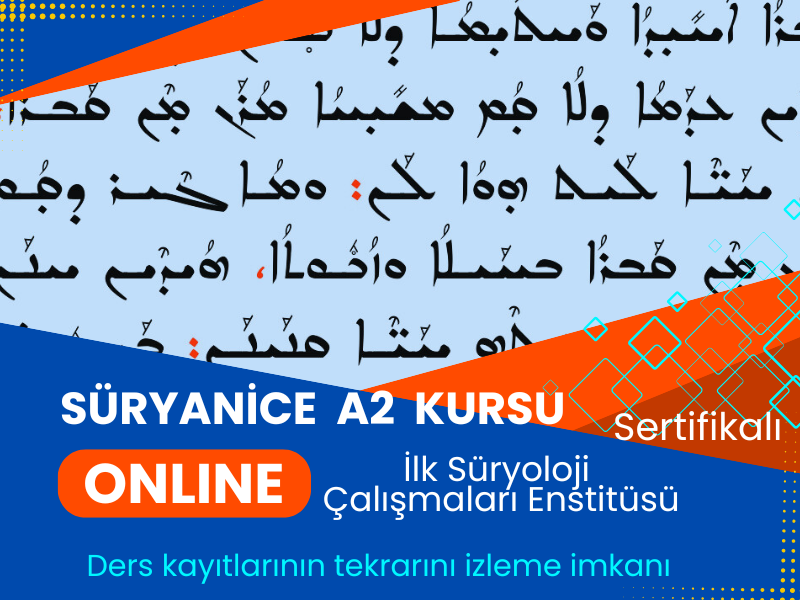
Programme content: The programme covers the syntax (sentence structure), orthography (writing system), phonetics (sound system) and morphology (word formation) of Classical Syriac, following the classical method while also observing international language-learning standards. It includes extensive exercises and homework to bring Classical Syriac to a solid beginner level in a short time.
Programme/course materials: All materials used in our courses are prepared by our expert team and continuously developed according to need. Materials are uploaded to our system weekly.
Notes; Aramaic/Syriac: Historically, the origins of Aramaic/Syriac can be traced back to around 3000 BC. It has historical roots in northern Syria and Mesopotamia going back to around 2000 BC.
Today Syriac is spoken primarily in Turkey as well as in Iran, Iraq, Syria and Lebanon, and is mainly used in churches as the official language of liturgy, literature and theology. It is also the common language of communication of Syriacs scattered across the world. In its historical regions it is divided into an eastern and a western dialect. These dialects are in turn divided into Classical Syriac (the literary language, kṭobonoyo) and Surayt (the vernacular, Turoyo). The education we offer here is based on Classical Syriac, which has a very deep history and in which tens of thousands of manuscripts and stone inscriptions created over the centuries have survived to the present day.
Contrary to common belief, on the educational journey we will take together into the mysterious history of the ancient world, at each stop we will experience the joy of learning the language alongside the unknown, adding value to ourselves as we read and decipher ancient texts.
Welcome to the ancient Syriac world…
NOTE 1: Course fees are paid upon final registration after pre-application. Turabdin Institute provides information on this matter.
NOTE 2: For one-to-one Syriac lessons, Syriac translation, consulting, Syriac studies trips and any Syriac studies project, you can reach us at info@turabdin.org.
Uzm. Süryolog: Adem Coşkun
Instructor details coming soon.